Edsols Applied AI Studio
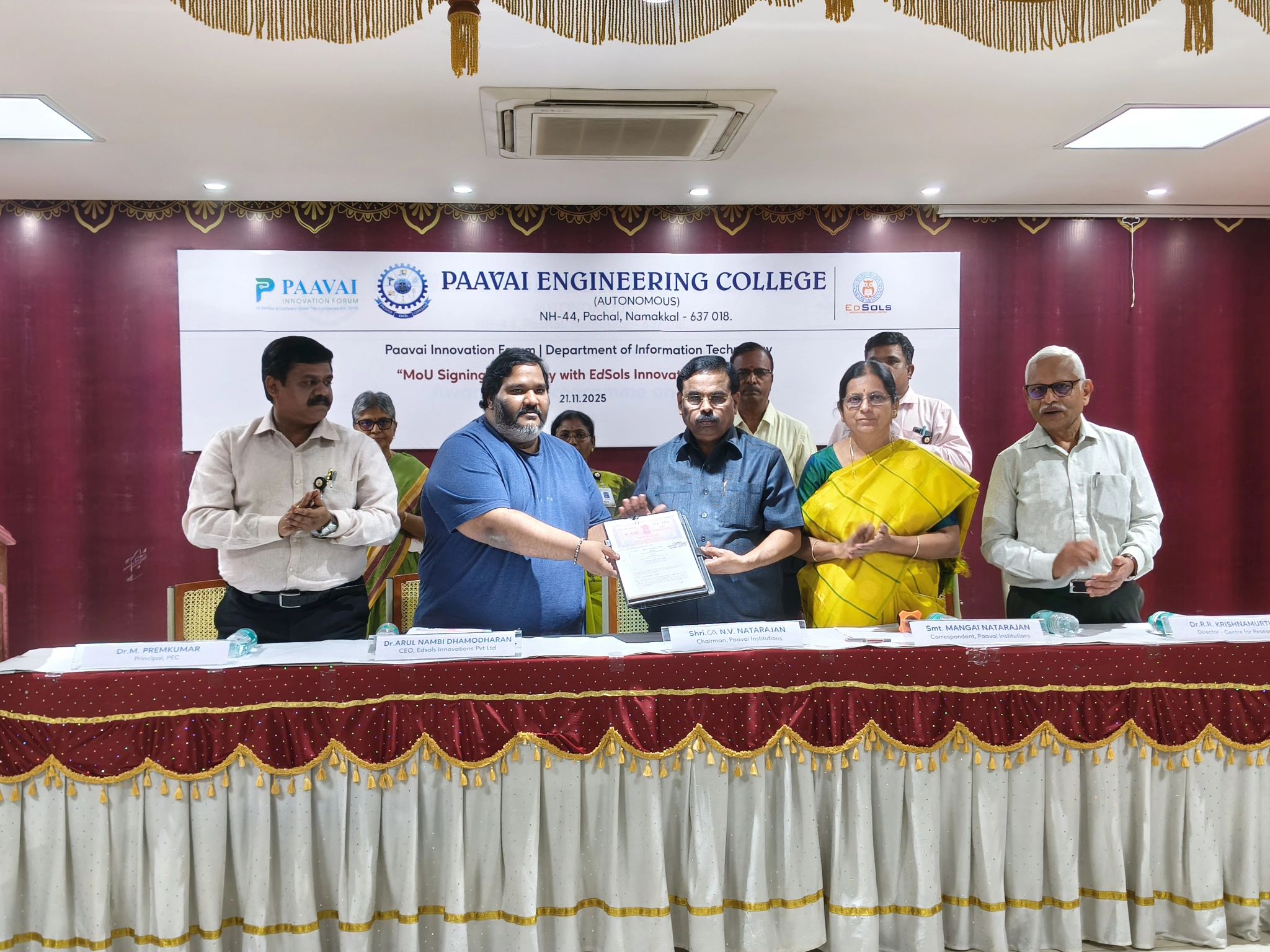
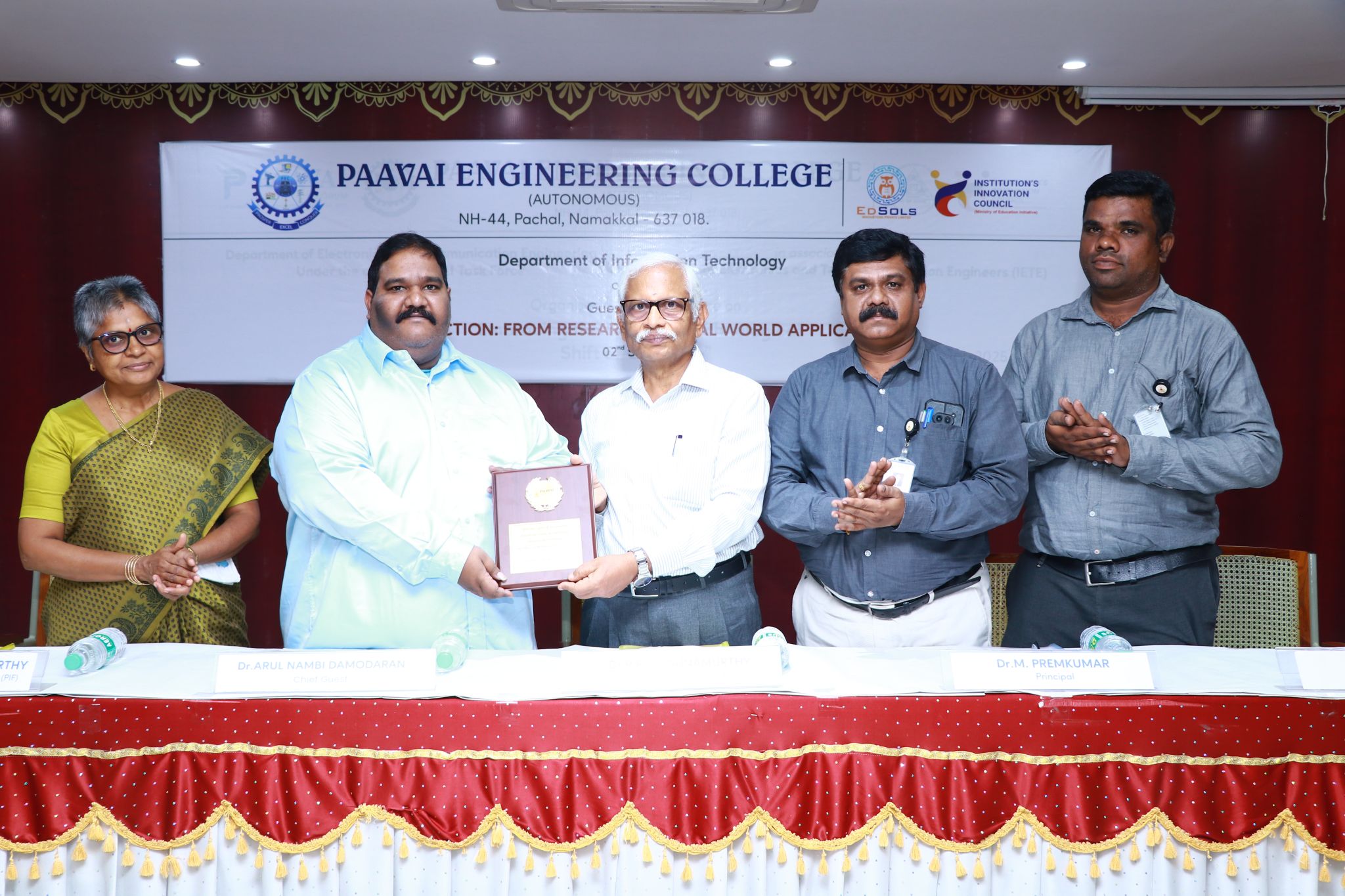
Collaborative CoE Establishment

A Centre of Excellence established at Paavai Innovation Forum — bridging academia and industry through AI, Robotics, IoT, and Emerging Technologies.

Scroll Down
Technology Partner
Innovation Partner
Our Purpose

Vision & Mission

A shared commitment to excellence — combining Edsols' industry expertise with Paavai Innovation Forum's innovation ecosystem.

🔭

Vision

  • Build the foremost industry-academic model in Tamil Nadu
  • Produce globally competitive, socially responsible graduates
  • Prepare students for the technology workforce of tomorrow
🎯

Mission

  • Bridge the gap between academia and industry
  • Empower students with future-ready tools, technologies, and certifications
  • Deliver programs through a structured Centre of Excellence at Paavai Innovation Forum
🏛️

Paavai Innovation Forum's Commitment

  • Deliver quality-based, value-added education aligned with international standards
  • Nurture holistic student development through emerging technologies and research
  • Uphold a deep commitment to social responsibility and ethics

Edsols' Commitment

  • Provide cutting-edge curriculum and hands-on lab kits
  • Offer CDAC and NVIDIA certifications for technology tracks
  • Provide direct industry exposure through internships and real-world project engagement
WHAT WE BRING TO PAAVAI

The EdSols Applied AI Studio

A dedicated hands-on learning environment covering five core pillars of future-ready engineering education.

Applied Artificial
Intelligence

Practical ML/AI projects — from model building to deployment

Computer Vision

Face recognition, object detection, image processing pipelines

Autonomous Systems

Self-driving cars, lane detection, collision avoidance

Intelligent Automation

Sensor integration, smart systems, process automation

Robotics

Robotic arms, sorting systems, IoT-driven robotic platforms

Collaboration

Collaboration Activities

Structured activities that bring together students, faculty, and industry under this partnership.

🖥️

Workshops & Hands-On Training

Delivered by Edsols-certified trainers. Structured around real kits, live projects, and student evaluations. Covers all technology domains with structured hands-on kits and student evaluations.

Recurring · Every Semester
🏆

Hackathons & Innovation Challenges

Team participation in Smart India Hackathon (SIH), national and international innovation events. Edsols provides technical mentorship, resources, and preparation support.

SIH · National & International
📐

Capstone Projects

Final-year students work on industry-mentored capstone projects aligned with Edsols' active R&D — producing real portfolio outcomes and publishable results.

Final Year · Joint Mentorship
💼

Internship Program

Top-performing PIF student innovators are offered internships at Edsols Innovations, Bangalore — working on live AI, Robotics, and Product Development projects with stipend support.

Stipend-Based · Performance Selected
🤝

Consultancy Project

Collaborative industrial consultancy projects solving real-world challenges, offering practical exposure and design-engineering solutions funded by Edsols Innovations.

Industry Funded · R&D Driven
👩‍🏫

Faculty Development Programs (FDP)

Training of Trainers (ToT) sessions equip faculty and PIF mentors to deliver CoE-aligned courses independently, building long-term institutional capacity and reducing dependency.

ToT Model · Faculty Empowerment
Curriculum

Edsols Applied AI Studio Curriculum

AI & Autonomous Systems Curriculum — Structured modules with kit-based hands-on learning.

Module 1

Hardware Integrated
NVIDIA Jetson Platform & Edge AI Deployment

Overview: This module provides a ground-up foundation in Edge AI computing using the NVIDIA Jetson platform. Students begin with core computing concepts—CPU architecture, GPU fundamentals, and why GPUs matter for AI—then progress through cloud vs. edge tradeoffs, NVIDIA's hardware ecosystem, Jetson board setup, OS flashing, library installation, AI model deployment via Docker containers, and finally hands-on project implementation.

🔑 Key Curriculum Topics
  • Introduction to CPU, GPU & Why AI Needs the GPU
  • Cloud vs. Edge, NVIDIA Ecosystem & Jetson Family
  • Flashing the OS & Installing Libraries on Jetson
  • Running AI Models & Docker Containers on Jetson
  • AI Algorithms, Project Ideas & Sample Project Build
🎓 Learning Outcomes
  • Explain the role of CPU and GPU in computing and articulate why GPUs are essential for AI workloads.
  • Compare cloud and edge computing architectures and select the appropriate deployment context.
  • Identify the NVIDIA Jetson product family and select boards based on TOPS and power requirements.
  • Flash JetPack OS on Jetson Nano and Orin platforms.
  • Install CUDA-compatible PyTorch, TensorRT, OpenCV, and supporting AI libraries.
  • Deploy pre-trained YOLOv8 object detection models for real-time inference.

Module 2

Hardware Integrated
🚗
Basic Autonomous Vehicle

Overview: This module builds the computer vision and machine learning foundation needed to develop a basic self-driving vehicle using the NVIDIA JetBot platform. Students learn how cameras see the world, how to collect and label training data, and how to optimize models for edge deployment.

🔑 Key Curriculum Topics
  • Introduction to Computer Vision — How Cameras See
  • Dataset Collection, Annotation & Augmentation
  • Image Classification & Basic Movement Control
  • Road Following — Regression Models & Camera Control
  • Collision Avoidance & Model Optimisation
🎓 Learning Outcomes
  • Apply OpenCV operations (resize, normalise, edge detect) to digital image tensors.
  • Collect and annotate custom datasets.
  • Fine-tune pre-trained ResNet-18 using transfer learning for collision avoidance.
  • Train regression models for road-centre coordinates and lane following.
  • Convert PyTorch models to TensorRT FP16 engines for increased inference speed.

Module 3

Hardware Integrated
🏎️
Advanced Autonomous Vehicle

Overview: Building on Module 2, this module covers the full lifecycle of an advanced autonomous driving system. Students implement an autopilot pipeline that detects traffic signs, obeys rules, and navigates multi-scenario environments, utilizing hardware like JetRacer and LiDAR systems.

🔑 Key Curriculum Topics
  • Autopilot Architecture & Multi-Task AI Pipeline
  • Traffic Sign Detection — Dataset & YOLOv8 Training
  • Training Deep Dive — Hyperparameters, Monitoring & Tuning
  • Model Testing, Evaluation & Validation Framework
  • Full Autopilot Integration & End-to-End Demo
🎓 Learning Outcomes
  • Design multi-task perception pipelines combining regression and object detection.
  • Configure and hyperparameter-tune YOLOv8 networks using Weights & Biases.
  • Formulate Finite State Machines (FSM) to handle dynamic traffic rules.
  • Evaluate performance using precision-recall curves and mean Average Precision (mAP).
  • Optimize multi-model architectures on edge hardware via concurrent execution.

Module 4

Hardware Integrated
🤖
AI-Powered Automation Using Robotic Arms

Overview: This module introduces students to the fundamentals of robotic manipulation combined with Edge AI intelligence. Students will transition from basic kinematic control of robotic arms to building fully automated, perception-driven automation pipelines. You will learn how to coordinate joint movements, implement real-time object detection and color tracking for automated sorting systems, integrate voice-based command interfaces, and build an end-to-end smart waste segregation system powered by deep learning classifiers deployed at the edge.

🔑 Key Curriculum Topics
  • Basic Robotic Arm Movement
  • Color Sorting using Computer Vision
  • Intelligent Object Sorting & Grasp Planning
  • Voice-Based Movement & Command Integration
  • Waste Segregation using AI Deployed on Hardware
🎓 Learning Outcomes
  • Program and execute basic coordinate and joint-space movements for a multi-axis robotic arm.
  • Calibrate camera-to-arm spaces (eye-in-hand or eye-to-hand) to achieve precise target positioning.
  • Implement color thresholding and contour-based tracking to automate high-speed color sorting tasks.
  • Deploy edge object detection models to identify, locate, and execute adaptive grasp planning for varying target items.
  • Integrate Natural Language Processing (NLP) or speech-to-text models to control mechanical arm paths via voice commands.
  • Design and execute an end-to-end intelligent waste segregation system that accurately classifies and sorts materials (e.g., recyclable, organic, hazardous).
  • Optimize multi-threaded control loops running perception and motor actuation simultaneously without latency bottlenecks.

Module 5

Hardware Integrated
🐕
Robotic Dog — Basic Movement & Person Following

Overview: This module introduces students to quadruped (legged) robotics using an AI-powered robotic dog platform. Students move from understanding how a four-legged robot balances and walks, to programming basic gaits and maneuvers, to building a computer-vision pipeline that detects and continuously follows a person — the platform's signature project for this module.

🔑 Key Curriculum Topics
  • Introduction to Quadruped Robotics & Legged Locomotion
  • Robotic Dog Hardware, SDK & Motion Control Setup
  • Gait Programming — Walk, Turn, Sit, Stand & Basic Maneuvers
  • Person Detection using Computer Vision (YOLOv8 / Pose Estimation)
  • Project Build: Real-Time Person-Following Behaviour
🎓 Learning Outcomes
  • Explain quadruped locomotion principles and compare legged, wheeled, and tracked mobility.
  • Set up and control a robotic dog platform through its SDK / ROS-based interface.
  • Program basic gaits and maneuvers (walk, turn, sit, stand) via joint and servo control.
  • Detect and track a person in real time using pretrained CV / pose-estimation models.
  • Implement a person-following behaviour using distance and bearing estimation inside a closed control loop.
  • Apply basic safety behaviours such as stopping on loss-of-target or obstacle detection.

Module 6

Hardware Integrated
🧠
Robotic Dog — Object Detection & Emotional Interaction

Overview: Building on Module 5, this module upgrades the robotic dog from a following companion into a perceptive, socially responsive AI agent. Students implement real-time multi-object detection for situational awareness, then design a facial emotion recognition pipeline and map detected emotions to expressive robot behaviours, culminating in a multimodal human-robot interaction demo.

🔑 Key Curriculum Topics
  • Real-Time Multi-Object Detection Onboard the Robotic Dog
  • Object-Aware Navigation & Interactive Response Behaviours
  • Facial Emotion Recognition — Dataset & Model Training
  • Emotion-to-Behaviour Mapping & Response Design
  • Project Build: Multimodal Vision + Voice Social Interaction Demo
🎓 Learning Outcomes
  • Deploy YOLOv8 for real-time multi-class object detection on edge hardware.
  • Design interactive behaviours triggered by detected objects (e.g., approach, avoid, alert).
  • Train and fine-tune a CNN-based facial emotion classifier (e.g., an FER2013-style model).
  • Design an emotion-to-behaviour response system mapping detected emotions to robot actions and expressions.
  • Integrate voice/speech cues with vision-based emotion detection for multimodal social interaction.
  • Evaluate and optimise combined perception pipelines for real-time performance on edge hardware.
🎓

Target Career Pathways

Autonomous Systems & Edge AI
Edge AI Engineer Computer Vision Engineer ADAS / Perception Engineer Embedded AI Developer
Social Robotics & Emotion AI
Social Robotics Engineer Emotion AI Engineer Robotics R&D Associate
Robotics & Industrial Automation
Robotics Automation Engineer Industrial AI Engineer Automation Solutions Engineer
Our Students

Internship Placements

Students who earned prestigious internships and career opportunities at Edsols Innovations through outstanding performance in CoE programs.

🎉 Outstanding Achievement

Proud Moment for the Department of IT!

We are delighted to share that two of our talented Final-Year IT students (Batch 2022–2026), Shalini. A and Aafiya Bareen. J, have secured a placement opportunity in this program with an Internship + Job Offer at Edsols Innovations Pvt. Ltd., Bangalore.
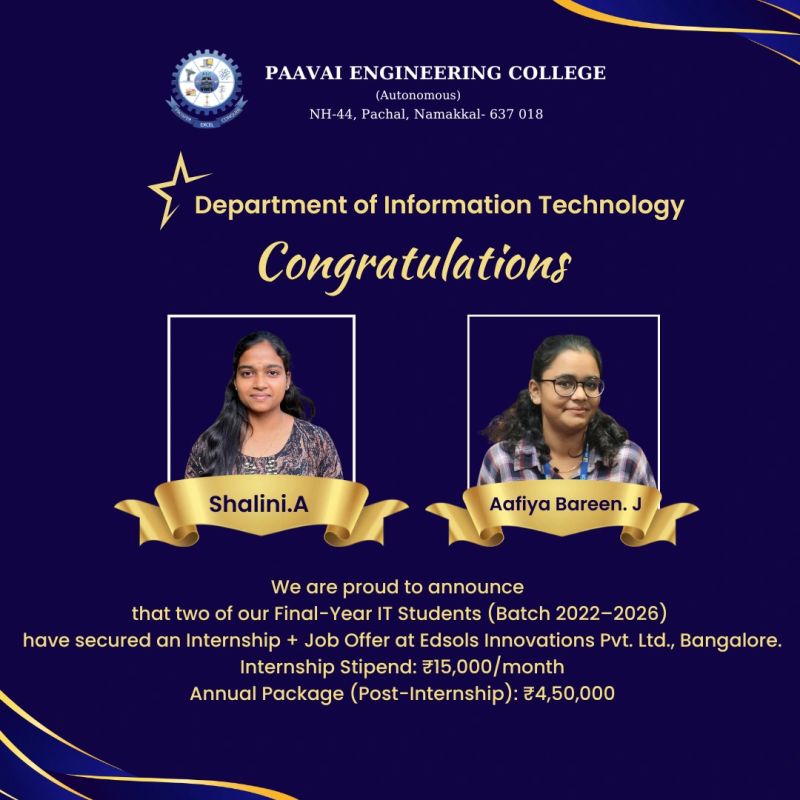
Internship Stipend ₹15,000 / month
Annual Package ₹4,50,000 CTC
Institution Partnership

Setup Edsols Centre of Excellence (CoE)
at Your Campus

Bring industry-aligned technology curriculum, hardware edge-AI setups, and certified hands-on training to your institution. Partner with Edsols to empower your students with real-world industry skills and placements.

To Setup CoE Contact: +91 82482 27512